Children’s Initiative Reinforces Healthy Eating Habits
I congratulate the new President of the Irish Hotels Federation for the “Food for Kids” initiative that he has just launched . As the father of two children I am only too aware of the very limited and unhealthy food offered to children in our hotels and restaurants . The standard choice of chicken nuggets ,sausages,fish fingers ,all deep fried and all served with chips ,must become a thing of the past . The healthy menu suggestions given to members by the IHF would appeal to my children and are all interesting and attractive options .
The initiative, which promotes more choice for parents, is the first nationally coordinated campaign of its kind in Europe. The IHF will provide chefs with healthy preparation guidelines along with a range of nutritious ‘Family Friendly Menus’ seasonally augmented in-line with the availability of fresh produce.
In partnership with independent dietitian Margot Brennan, the initiative will see the roll-out of a comprehensive range of menu options across participating hotels and guesthouses from May 2008 onwards. With an estimated 300,000 children now overweight or obese in Ireland1, the ‘Family Friendly Menus’ will offer parents fun, interesting and healthy meals that reinforce healthy eating habits with an optimum balance of proteins, carbohydrates and nutrients.
In 2008, Irish hotels and guesthouses will prepare over five million meals for children, providing a significant opportunity to promote healthy eating among their younger guests. Coordinated and supported by the IHF, participating premises will help to address the pressing health issue of childhood obesity by delivering nutritious meals that are tasty, attractive and fun for children.
The healthy eating guidelines will promote:
- Eliminating salt in preparation and cooking
- Offering alternatives to chips
- Using ‘real potatoes’ to make homemade chunky chips with no added salt
- Using vegetables & fruit more imaginatively
- Increasing the use of whole-wheat and oats.
- Providing less fried foods
- Increasing the fibre content in children’s food
- Ensuring a child-friendly presentation of food
- Providing fish, chicken and meat that are nutritious and not processed.
The IHF stated that it hoped that this initiative will play a role in addressing alarming national statistics which include:
§ 11.6% of Irish girls aged 5–12 years are overweight while 13% are obese
§ 10.5% of Irish boys aged 5–12 years are overweight while 9.2% are obese
§ 40% of Irish children exceed the recommended maximum of energy intake from fat.
§ 61% of children did not consume enough fibre.
The IHF stated that hotels and guesthouses participating in the initiative will display a symbol so that parents can also make an informed selection on the property they choose to have family meals in. The IHF represents over 1,000 hotels and guesthouses throughout the country. Its members employ 60,000 staff.
I will be encouraging all our hotels to look at improving the children’s menu’s that we offer to include some of the suggestions outlined in this initiative .
For more information visit www.ihf.ie
By Simon Binns Crain’s Manchester Business
Manchester’s serviced apartment sector is growing and now boasts the biggest range in the UK outside of London, according to a new report from agents Savills.
The capital leads the way by some distance, with 5,200 units. However, Manchester currently has 338 units followed by Birmingham (258), Leeds (143), Bristol (125), Edinburgh (207) and Cardiff (42).
Serviced apartments in Manchester city centre include The Place, near Piccadilly Station, and Days Inn and Premier Apartments, both in the Northern Quarter, and new developments such as BSC Group’s Issa Quay on Dale Street are expected to come onto the market soon.
The Savills report claims that income returns for serviced apartments have outperformed the residential investment sector, averaging 4.4 per cent over the last three years, compared to 3.7 per cent for the private rented sector. The report predicts this trend will continue in 2008 with similar income returns of between five and 5.5 per cent.
Adrian Archer, director of Savills hotels division, said branding would be key to raising the profile and appeal of the sector. “This can open the sector up to new sources of demand, such as new international markets and the leisure sector. This could drive further expansion.” Further supply would also depend on developers coming into the sector, the report said.
“Past investment performance and its exclusion from affordable housing requirements makes this sector attractive to developers,” said Archer. “It also gives them the option of selling units back onto the private residential market at a later date realising any potential future uplift in values. This has become increasingly attractive in markets suffering an oversupply, combined with thinning demand for city centre flats.
“But if developers want to get maximum value from their scheme they should be looking to get an operator on board at an early stage”.
Mark Hiscock is general manager at Premier Apartments Manchester, on Shudehill. He said that some business travellers prefer the home-from-home feel of a serviced apartment when on business travel.
“A lot of our customers have stayed in hotels before but like the extra space and flexibility of serviced apartments,” he said. “People often like to have a bit of independence when they are travelling for business. We have a reception if people need to contact us, but some people like to be left alone and want a more hands-off approach.”
The room rate at Premier Apartments is £90 for a one-bedroom flat, but it can increase to £200 on a busy night. “Some times are busier than others — conferences season and Manchester United fixtures are the busiest time,” he said.
“During the week, our customers are predominantly corporate. We have quite a few regulars who will stay Sunday to Thursday or Monday to Friday. We also have long-stay relocations or assignments. Some stay for as long as three months.
All 29 ‘People of the Year’, representing properties from
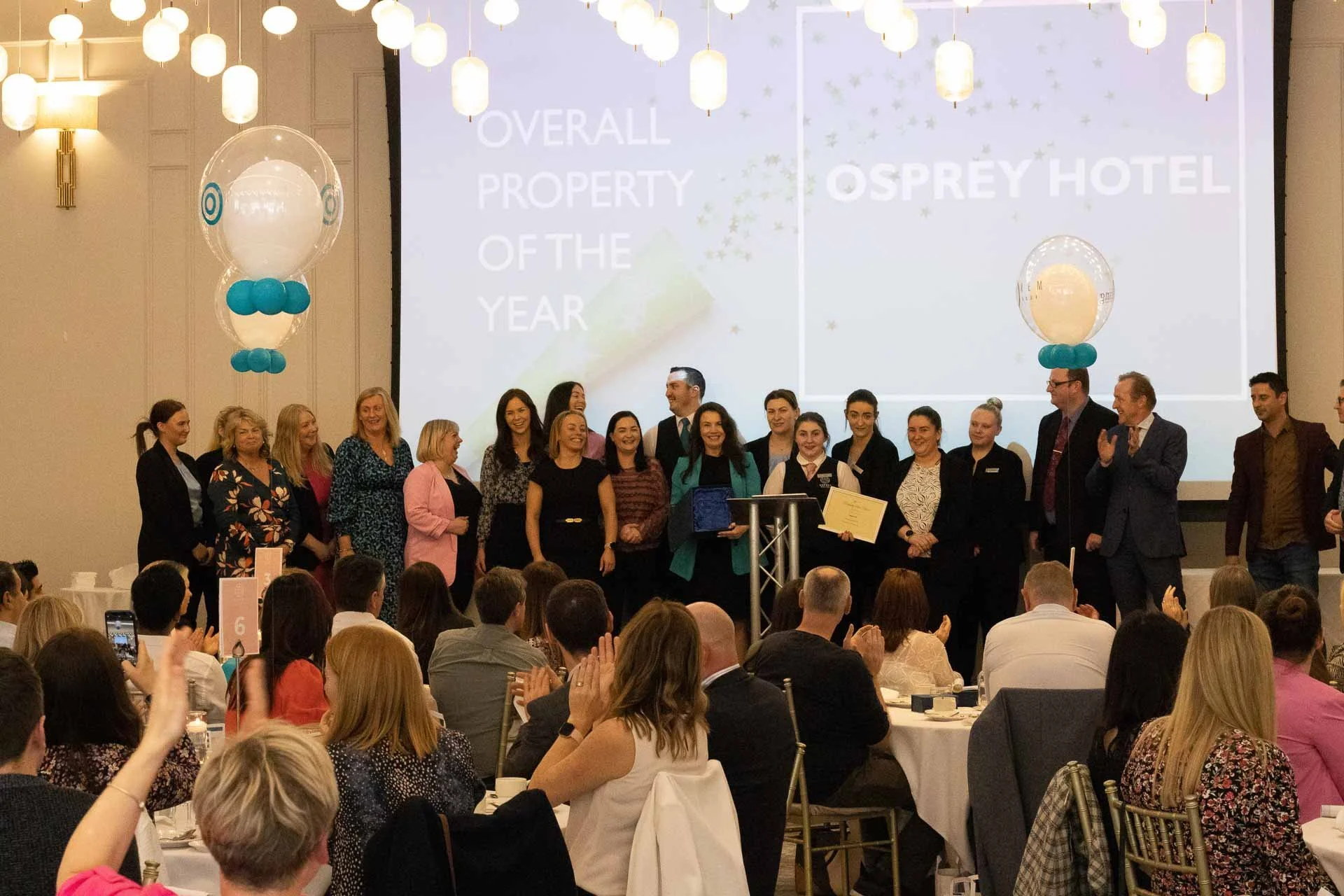
With just one week to go to the inaugural PREM Group awards ceremony in the Days Hotel Galway on the 24th April, plans are really beginning to take shape. On the night we will be celebrating the persons of the year from Ireland, England, Belgium and France. The person of the year winners from all of our 38 properties will be travelling to Galway with their GM’s to accept their award. On the night we will be picking one overall person of the year for each region . We will also be selecting the overall property of the year from across the portfolio. Needless to say we have a great night planned for all attendees and I have no doudt that the team in Galway will give us a night to remember.I will have a list of winners on this blog after the event along with a few photos. Expect a few sore heads on Friday morning !!
One of the best hotel blogs out there is Bill Marriott’s blog at www.blogs.marriott.com and I enjoyed reading this post . Hopefully he wont mind if I repeat it here .
“There’s an awful lot of conversation today about the difficulties we’re all having to understand what’s going on with our economy. None of us really know how long this downturn is going to take or how severe it’s going to be. The only thing we’re certain of is that we need to all learn to think outside the box. We need to be creative, we need to be innovative, we need to find ways to tackle our problems and really think about what we can do to do better.I was impressed with a story I heard a little while ago about an old man who lived alone in the country. He was worried about digging his tomato garden because it was such hard work and the ground was hard. His only son Vincent, who used to help him, was in prison. The old man wrote a letter to his son and described his predicament:
Dear Vincent,
I’m really feeling bad because it looks like I won’t be able to plant my tomato garden this year. I’m just getting too old to be digging up a garden plot. I know if you were here my troubles would be over. I know you would be happy to dig the plot for me.
Love,
Dad
A few days later, he received a letter from his son:
Dear Dad,
Don’t dig up that garden, that’s where I buried the bodies.
Love,
Vinny
At 4:00 a.m. the next morning, FBI agents and local police arrived and dug up the entire area without finding any bodies. They apologized to the old man and left. That same day the old man received another letter from his son:
Dear Dad,
Go ahead and plant the tomatoes now. That’s the best I could do under the circumstances.
Let’s all work hard at thinking outside the box, being creative and solving problems.”
- Hotels.com Hotel Price Index (H.P.I.) is a regular survey of hotel prices in major destinations across the world. The HPI tracks the real prices paid per room for a wide basket of hotels, weighted to represent hotels in every star category in major destinations. Approximately 60,000 hotels in over 6,500 locations make up the sample of hotels from which prices are taken. The prices shown are those actually paid by customers (rather than advertised rates) and therefore give an accurate reflection of hotel prices for the period.
As you would expect there are some interesting results for 2007.
- Average hotel rates were generally flat for the world as a whole in 2007. Prices in Europe and Asia rose by 4.5% and 3.3% respectively, while prices in the US and the rest of the world fell.
- Room rates in Ireland remained the same last year as in 2006; probably reflecting increased capacity and competition.
- Within Europe, the UK tops the list of most expensive destinations ahead of Norway, Switzerland, Italy, Denmark, Sweden, the Netherlands, Austria, Greece, Finland and France, in that descending order.
- Next in 12th place is Ireland, just ahead of Spain, Belgium, Slovakia, Germany and Portugal.
- The UK posted year-on-year (2006 vs. 2007) price rises of 12%, according to Hotels.com. This drove average room rates to £106 per night, making it the most expensive country to stay in for travellers in 2007, and the only one where the AVERAGE cost of a room is over £100 per night.
- At the other end of the scale, Orlando was the cheapest of the major cities used in the survey with room prices averaging £55 (the rate of exchange would have something to do with that). Other “bargains” were Bangkok at £58, Shanghai at £61, Beijing at £66 and Buenos Aires at £70.
- The most expensive cities were Moscow at £194 followed by New York at £143, Dubai and Venice were next at £125, while London was the 5th most expensive at £115.
- Dublin came in 34th position at an attractive average room price of £78, behind such cities as Edinburgh, Rome, Paris, Boston, Sydney, Madrid, Hong Kong and many other.
- Coming closer to home the survey finds that while London was 5th highest of the major world cities, it was only in second place in the UK, coming in behind beautiful but expensive Bath at £117. Oxford was in 3rd position at £113 while surprisingly (perhaps) next was Aberdeen at £109.
- Coventry became the cheapest city in the UK during 2007 at an average of just £57 per night. Now do you think the Munster fans will get rates like that when they travel to the semi-final in the Ricoh Stadium to do the business with Saracens at the end of this month? Dream on…..
- The report also finds that prices in Ireland in 2007 were flat year-on-year, and that Limerick saw the biggest drop, achieving an average room rate of £56, which was down 22% on 2006. It suggests the reason being that the city has seen a number of new hotels open up creating opportunities for bargain hunters.
- Galway on the other hand topped the Irish league at £94 per night on average, followed by Cork at £85. You might find it surprising that both were ahead of Dublin at £79.
- Hotel.com looked at what different nationalities spend on their hotel rooms, and here you are in for a surprise. Irish travellers were Europe’s biggest spenders, prepared to spend £99 on hotel rooms on average when travelling overseas. They topped UK travellers who spent on average £93.
- The Irish also spent the highest amount in some of the most popular destinations – they were the biggest spenders when visiting Paris, Barcelona and Madrid.
- Germans are rather unsympathetically described as Europe’s cheapest visitors willing to part with just £82 per night on average when travelling abroad. Of course what that proves is that they are better bargain hunters, something we could well learn from.
- On balance it seems fair to conclude that Irish hotels offer good value, something that has been correctly highlighted by the Irish Hotels Federation for some time.
April 10th 2008
Irish Tourist Industry Confederation
Brussels has shot up from 16th to fifth place in the international league table of cities ranked according to their attraction for business investors in the property market, according to a study by PriceWaterhouseCoopers and Urban Land Institute. Brussels owes its rise to the feeling of safety felt by investors, the study says. Brussels has failed to fall victim to the excesses in the property market felt by other major cities. The table is headed by Paris, taking over from London which drops to ninth place. Munich is second, followed by Zurich and Hamburg. The PwC study was carried out among 500 property experts in 27 countries. Brussels was also given a high ‘hold’ score by the property experts surveyed – meaning their advice to owners is not to sell.
This is good news for PremGroup as we are are working on three projects in Brussels at the moment . We expect to have two hotel deals done for this market by the end of this year . These two new hotels will compliment the Holiday Inn Brussels-Schuman that we operate in the city .
Over the last few weeks there has been some comment in the media from Taxi representatives that there is now an over supply of taxis in Ireland and in Dublin in particular . From a consumer viewpoint it is indeed easier to get a taxi these days and surely that is a good thing particulerly on weekend nights . It is a pity that when the taxi regulator was deregulating the industry they did not use the opportunity to deal with the standard of taxis on our roads . I recently had some Belgium clients in Dublin and we needed a taxi for four persons . The taxi arrived on-time when we ordered it ,but you should have seen the faces on my colleagues when they saw the car that arrived for us . Four of us had to squeeze into a 1999 Toyota Corolla that in my view had seen better days . Now I have nothing against the Toyota Corolla ,I think I owned one at some stage ,but surely this model was not designed to be a taxi . At best it was designed to carry three passengers in some comfort ,not four adults plus the driver .Given the age of the car I would question its road wordiness as a commercial vehicle ,yet I am sure if asked the owner could show it had passed the necessary tests . Contrast that experience if you order a taxi in most other European country’s .If you arrive in Brussels airport for example you will be met by a line of taxi’s all the same color ,all of a sufficient size to take four passengers in comfort ,most will be Mercedes or similar and all will be spotlessly clean both inside and out . Is it not time that we made moves to standardise the taxi fleet in Ireland . I have no doubt the Taxi unions will say that the cost of the cars in Ireland are much higher than in the rest of Europe ,etc,etc,. Someone needs to tackle all these issues and set a target to improve the quality of the product for the consumer . Perhaps a tax incentive ,similar to the Capital Allowance scheme that was available to Hotels could be designed for new taxis . In the Hotel sector we have a modern world class hotel product ,much of which would not exist if it were not for the capital allowance schemes of the last two decades .
Over the last three months we have been bombarded with information on the slowdown in the US economy and the impact that it would have on the economy’s around the world . I don’t know about you but I am beginning to find the information overload and analysis in the business pages a bit tedious . Who really knows what the next few months has in store ? In Ireland the American market is critical to the success of our tourist industry . After a pretty poor first quarter we are all hoping for a pick up in the coming months as the season gets into its stride . Given the weakness in the dollar ( and more recently sterling ) you would wonder why anyone in America would even consider venturing outside of the United States for there hard earned vacation . Yet you have to remain optimistic and try and search for some positives among all the doom and gloom . Therefore it was somewhat reassuring to get the following a opinion on the American situation from the Irish Tourist Industry Confederation . Lets hope this analysis is correct .
- This week the International Air Transport Association (IATA) downgraded its industry profit expectations for 2008 to $4.5 billion, based on global economic growth slowing to 2.6% and an average annualised oil price of $85 per barrel. That’s the second downgrading since September last when IATA predicted $7.8 billion profit for this year, and that figure was revised downwards again in December to $5 billion.(IATA represents some 240 airlines comprising 94% of scheduled international air traffic).
- At an average annual price of $86 per barrel, fuel represents 32% of airline operating costs and a total bill of $156 billion, according to IATA
- Nonetheless passenger demand increased in February by 4 to 5%, though this was well down from the demand growth of 7.4% in February of last year. Things are slowing down according to IATA boss Giovanni Bisignoni.
- The full introduction of Open Skies on March 31st complicates forecasting too. For instance there are 25% more weekly flights scheduled to serve the US market out of Heathrow. It is reasonable to assume that consumers will benefit from greater choice and lower fares due to intensified competition.
- Although there is only a marginal increase in capacity on Irish transatlantic routes, we should also benefit from greater choice and lower fares. Aer Lingus have direct services from 3 new gateways, San Francisco, Washington DC and Orlando (these new routes were introduced last Autumn).
- The US credit crunch has clearly dented consumer confidence.
- According to a New York Times/CBS poll, Americans are more dissatisfied with the country’s direction than at any time since this poll started in the early 1990’s.
- 81% of respondents believe “things have pretty seriously gotten off on the wrong track”, up from 69% a year ago and 35% in early 2002. There is now, it appears, nearly a national consensus that the country faces significant problems.
- 78% of respondents said the country was worse off now than 5 years ago, just 4% said it was better off. Only 21% of respondents said the overall economy was in good condition.
- Interestingly the poll found that Americans blame Government more than banks or borrowers, with 40% blaming the Regulators, 28% blaming the lenders and 14% blaming the borrowers.
- Also interestingly a clear majority favoured Government help for individuals but not for financial institutions, even if the measures would help limit the depth of a recession.
- Perhaps somewhat reassuringly, more than 70% said their financial situation was fairly good or very good, which is only slightly down on 2006.
- Curiously the poll found that 43% of those surveyed said they would prefer a larger Government that provided more services, while an identical 43% said they wanted a smaller Government that provided fewer services.
- As for the longer term, only 46% of parents said they expected their children to enjoy a better standard of living than they themselves do, down from 56% in 2005. In more general terms about the next generation, only a third believe it would live better than people do today. That suggests a current lack of confidence and natural parental concerns. It is very probable that every generation of parents believed similarly from time to time, but the reality has always been different.
- The nationwide New York Times/CBS poll was carried out by phone between March 28th and April 2nd and the margin of sampling error was plus or minus 3 percentage points.
- But consumers are resilient, none more so than US consumers, and many many millions will vacation as always this year. Europe and Ireland will get their share thanks to competitive access costs, though we will probably see fewer than we would have predicted 6 months ago. Lower fuel costs, a stronger dollar and a pick up in US consumer confidence are what is needed.
- And perhaps that’s on the way. At a recent forum called A Wall Street Look at the Business of Business Travel, Ken McGill, Executive Vice-President and Managing Director, travel and tourism, for the economic analysis firm Global Insight, said that the US is currently in a recession. He added it was “mild”, and that the negative growth will last only two consecutive quarters, which is generally described as the minimum time frame of a recession.”The global economy is both robust and broadly distributed, and the interplay between growing and slowing economies around the world will help the US economy recover quickly”, he added.
He also predicted that both increases in fuel prices and decreases in the value of the dollar would moderate in the medium term, contributing to recovery. “The global economy is a good-news story: slowing growth, then getting back on track.”
Let’s hope Ken is right.

Enlarge